
Choosing between a Sungrow vs GoodWe hybrid inverter often comes down to how you want your solar and battery system put together. In this guide we compare two current 10 kW single-phase models sold in Australia: the Sungrow SH10RS and the GoodWe ESA GW9.999K-EHA-G20. On paper they’re closely matched, but they take different approaches to design, backup and batteries. Sunloop Energy installs both brands, so we’ll stick to the published specs and explain which suits which household.
Quick verdict
- Choose the Sungrow SH10RS if you like a separate, compact wall-mounted inverter, you want to choose from Sungrow’s SBR, SBH or SBS050 batteries, or you may later want the wider Sungrow range.
- Choose the GoodWe ESA if you want an all-in-one stack with inverter and battery in one tidy column, strong whole-home backup figures and the higher IP66 rating.
- Either way, both accept up to 20 kW of solar on four MPPTs and carry a 10-year Australian warranty, so your site, switchboard and battery size should decide it. There’s no blanket winner here.
Sungrow vs GoodWe hybrid inverter specs side by side
| Specification | Sungrow SH10RS | GoodWe ESA GW9.999K-EHA-G20 |
|---|---|---|
| Design | Separate hybrid inverter | All-in-one inverter module on a battery stack |
| Rated AC output | 10 kW | 9.999 kW |
| Maximum solar input | 20 kWp (recommended maximum) | 20 kW |
| MPPTs | 4 (one string each, 20 A per MPPT) | 4 (one string each, 20 A per MPPT) |
| Maximum PV voltage | 600 V | 600 V |
| Battery voltage range | 80 to 460 V | 350 to 550 V |
| Inverter battery power | 10 kW charge and discharge | 13.5 kW charge, 11 kW discharge |
| Backup output | 13.68 kVA peak for 10 seconds | 10 kVA nominal, 20 kVA peak for 10 seconds |
| Listed switchover time | Under 10 ms | Under 4 ms |
| Maximum efficiency | 97.5% | 97.5% |
| Enclosure rating | IP65 | IP66 |
| Inverter size (W x H x D) | 605 x 435 x 181 mm | 800 x 300 x 270 mm |
| Inverter weight | 29 kg | 26 kg |
| Noise | 35 dB(A) | 35 dB or less |
| Cooling | Natural convection | Natural convection |
| Operating temperature | -25 to 60°C | -35 to 60°C, derating above 40°C |
| Monitoring | iSolarCloud | SEMS |
| Inverter warranty in Australia | 10 years | 10 years |
Design: separate inverter or all-in-one?
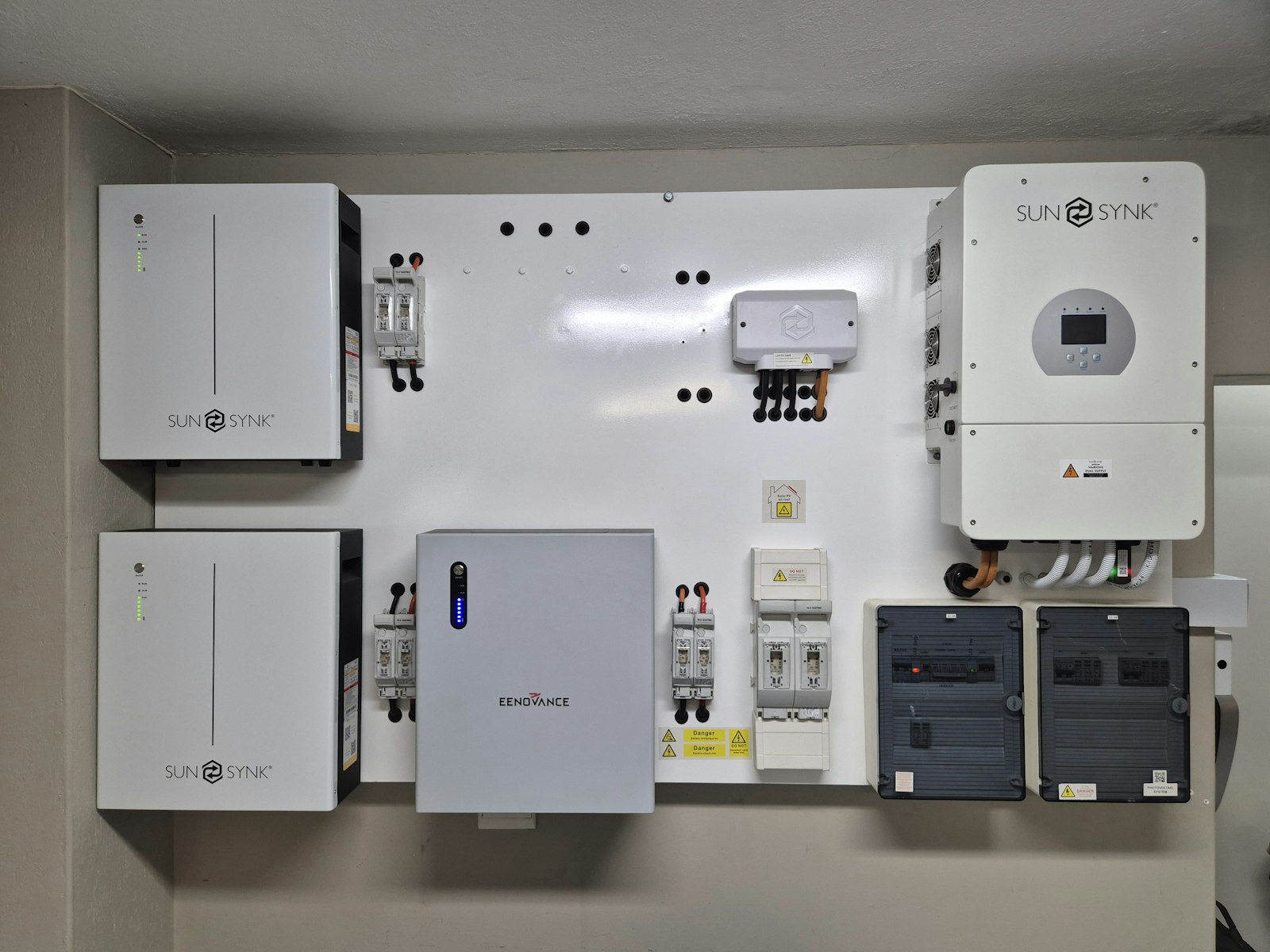
This is the biggest practical difference. The Sungrow SH8.0/10RS is a conventional hybrid inverter that mounts on the wall, with the battery installed as a separate unit. At 181 mm deep it’s slim, which can help in a tight side passage or garage.
The GoodWe ESA is built as a pre-wired modular system. The inverter module and battery modules share the same footprint, so the finished stack reads as a single column. GoodWe lists wall or floor mounting for the inverter. If you value a clean look, that’s a real plus. The trade-off is that the inverter is designed around the ESA system, so most buyers will treat it as one package rather than picking parts separately.

Capacity and scalability
Sungrow lists the SBH, SBR and SBS050 battery families as compatible with the SH8.0/10RS. The SBR uses 3.2 kWh modules, and the larger SBH series uses 5 kWh modules. Not every battery size suits every inverter, so the exact pairing needs checking against Sungrow’s compatibility chart.
GoodWe’s Australian ESA range uses 5 kWh and 8 kWh usable battery modules (GW5.1 and GW8.3), and GoodWe says capacities can be mixed, with stacks quoted up to 54 kWh. Module sizes matter for power too: each 5 kWh module is rated to 5 kW and each 8 kWh module to 8 kW, so a small battery may not reach the inverter’s full discharge rating.
Bigger isn’t automatically better. Start with your evening usage, and use our guide on how to size a home battery before comparing quotes.
Power output and solar input
On solar, the two are almost identical. Both offer four MPPTs with one string each, 20 A per MPPT, a 600 V maximum and up to 20 kW of panels. Four MPPTs are useful on homes with several roof faces, because each direction can be tracked separately. Our solar inverter guide explains how this fits in with other inverter types.
On the battery side, GoodWe’s published inverter limits are higher, at 13.5 kW charging and 11 kW discharging, compared with 10 kW each way for the Sungrow. That can help a large battery fill faster on a sunny day, as long as the battery itself can accept that power. In practice, your network’s export and inverter limits may matter just as much, so see solar export limits explained.

Backup during a blackout
Both inverters support backup, and both switch over quickly enough that many appliances won’t notice. Sungrow’s datasheet lists under 10 ms and GoodWe’s lists under 4 ms, though Sungrow’s product page describes the changeover as 0 ms, so compare the datasheets rather than marketing lines.
GoodWe’s strength is its published backup capacity: 10 kVA nominal, 20 kVA peak for 10 seconds and a 63 A bypass rating, with GoodWe promoting full-house backup and no separate gateway. Sungrow lists a backup peak of 13.68 kVA for 10 seconds, and promotes 24/7 full backup. Which circuits stay on still depends on how the system is wired, your battery’s power rating and your state of charge. Whole-home backup is a design decision, as we cover in can batteries power a whole house?
Weather rating and noise
Both units are fanless, using natural convection, and both list about 35 dB, which suits installation near living areas better than a fan-cooled unit might. GoodWe has the higher IP66 rating against Sungrow’s IP65, and a wider listed low-temperature limit. Either rating suits outdoor use, but the location must still meet Australian rules, particularly for the battery.
Warranty
Both brands offer 10 years on the inverter in Australia. Sungrow’s Australian inverter warranty runs for 10 years from installation, capped at 11 years from manufacture, and lists the SH8.0RS and SH10RS. GoodWe’s ESA warranty for Australia and New Zealand lists 10 years on the all-in-one inverter and on the GW5.1 and GW8.3 batteries.
GoodWe’s battery performance terms promise 70% of usable energy at 10 years or a minimum throughput, whichever comes first: 18.25 MWh for the 5 kWh module and 29.2 MWh for the 8 kWh module. Sungrow batteries have their own warranty, so check the terms for the model on your quote. It’s also worth asking how each warranty treats virtual power plant use. Your rights under Australian Consumer Law apply as well.
Compatibility and three-phase homes
The models compared here are both single-phase. If your home is on three-phase power, each brand has a separate path:
- Sungrow: its SH-T hybrid range, including the SH5 to SH12T, offers three-phase inverters with direct PV inputs, and Sungrow lists SBH and SBR compatibility.
- GoodWe: the three-phase ESA 5-30 kW AC-coupled system runs from 5 to 30 kW. Its datasheet lists no PV inputs, so it’s aimed at adding storage on the AC side, which can suit a home with an existing solar inverter.
If you already have solar, tell us your inverter brand and age. It may be worth keeping and adding an AC-coupled battery, or replacing it with a hybrid. See how to bundle solar battery upgrades.
Installation considerations
- Space: the Sungrow needs wall space for the inverter plus a separate spot for the battery. The GoodWe needs one taller column.
- Location: battery placement must comply with AS/NZS 5139, wherever the inverter goes.
- Switchboard: older boards can limit either option, particularly for whole-home backup. See our switchboard upgrade guide.
- Solar layout: your roof faces and string design will decide how the MPPTs are used.
- Monitoring: Sungrow uses iSolarCloud and GoodWe uses SEMS, so ask to see each app before you decide.

Cheaper Home Batteries eligibility
The federal discount applies to the battery rather than the inverter, but the whole system still matters. Under the Clean Energy Regulator’s rules, the battery must be on the Clean Energy Council’s approved list, be VPP capable and be installed by an accredited installer with a battery endorsement. Sungrow promotes the SH10RS as VPP ready. For either brand, we’ll check the exact battery and inverter combination against the current approved list and confirm it on your quote.
Since 1 May 2026, the discount has been tiered: the first 14 kWh earns the full rate, then it tapers. At about $40 per certificate, a 14 kWh usable battery installed between May and December 2026 earns very roughly $3,800. Certificate prices vary, and the STC factor falls from 6.8 to 5.7 on 1 January 2027. Our guide to the Cheaper Home Batteries Program has the details, and our rebates page covers other incentives.
Which suits which household?
The Sungrow SH10RS suits
- Homes that want a slim wall-mounted inverter with the battery located separately
- Buyers who want a choice of battery families, including the larger SBH
- Sites where a separate inverter and battery location works better than a single stack
The GoodWe ESA suits
- Homes installing solar and a battery together that want one neat, integrated stack
- Households that place a high value on published whole-home backup capacity
- Exposed locations where the IP66 rating is an advantage
Read more on our Sungrow battery and GoodWe battery pages, or see Tesla Powerwall 3 vs Sungrow SBH and Fox ESS CQ7 vs GoodWe ESA for battery comparisons.
FAQ
Is Sungrow or GoodWe better for a hybrid inverter?
Neither is better for every home. Solar input is closely matched, GoodWe publishes higher battery and backup figures, and Sungrow gives you a slim standalone inverter with a choice of battery families.
Can I add a battery later?
Both systems are designed around modular batteries, but the battery must be compatible and the rules for the discount apply at the time of installation. Ask us to plan for it at the start.
Do these inverters work on three-phase power?
The SH10RS and ESA GW9.999K-EHA-G20 are single-phase. Both brands offer separate three-phase products, which work differently, so ask which suits your home.
Will a hybrid inverter keep my power on in a blackout?
Only with a suitable battery and backup wiring. A hybrid inverter on its own doesn’t guarantee backup, so ask your installer which circuits are covered.
Get a quote from Sunloop Energy
The right answer to Sungrow vs GoodWe depends on your roof, switchboard, backup needs and battery plans. Request a free quote from Sunloop Energy and we’ll review your bills, check your site and recommend the hybrid inverter that makes the most sense for your home, with any battery discount clearly shown on your quote.